Designing pants around sitting, not hiking
The Axis Pant starts from a desk chair, a train seat and a bike saddle. Changing the starting posture moves almost every pocket.
BY FIELD // LAB / / 3 MIN READ
Start with the posture.
Most technical pants are patterned for walking uphill. The knee is shaped for a long stride and the gusset for high steps. Storage sits where a map is easy to grab while moving.
Our wearers spend far more of their hours seated. Desks, airplanes, trains, workshop stools. Many commute by bike, which is its own seated position: hips rotated forward, knees coming up high on every pedal stroke.
So the Axis Pant starts there. We asked what happens to fabric and pockets when someone bends at the hip and knee for most of a day, and designed from the answer.
Where pockets go when you sit.
Sitting changes the shape of the leg. The hip crease folds and the front of the thigh flattens out like a shelf. A phone in a standard front pocket rotates, digs into the hip and sometimes slides out onto a train seat. Bulky storage on the thigh becomes a lump you sit on all afternoon.
Our design goal is storage that stays flat and reachable while seated. The Axis Pant has a low profile phone pocket positioned away from the hip fold. Its foldable device geometry is meant to fit the thicker profile of a folded phone as well as a standard one.
A hidden passport pocket is for travel days, when the passport needs to come out at a gate and go back without a search. A separate AirPods pocket keeps the case away from keys. A tool and pen channel gives a pen, stylus or small screwdriver its own narrow slot.
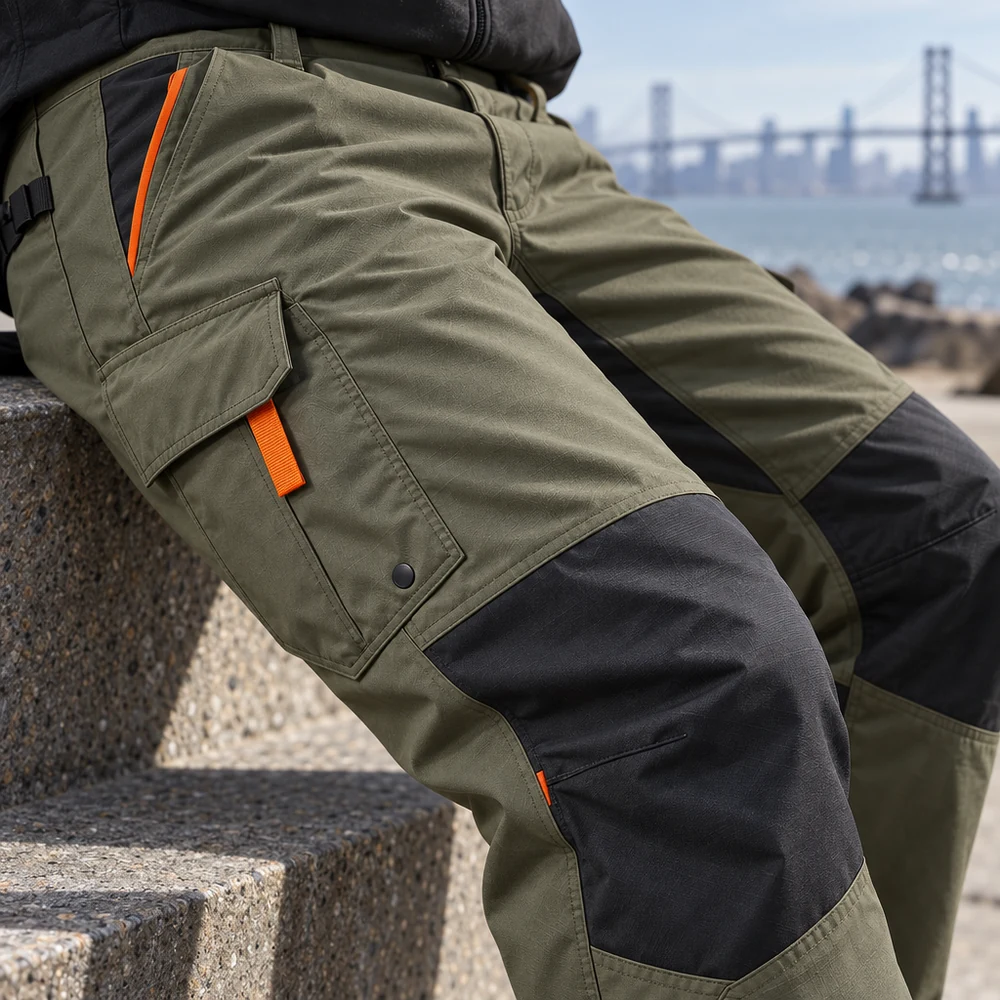
The current design also has flapped pockets on the outer thigh. They are cut flat and sit to the side rather than on top of the leg, so they are for light, flat things you reach for while standing: a transit card, a folded map, gloves. The phone and anything thick belong in the pockets above. If the flaps turn out to press into the leg when seated, they get flatter or move.
Every one of those positions is a hypothesis. A pocket placed on a flat pattern can end up somewhere else once the knee bends. Checking that is one of the first jobs for a fit sample.
Knees, seat and waistband.
Sitting pulls fabric tight across the knee and seat. Pedaling repeats that pull hundreds of times on one commute. The Axis Pant is designed with articulated knees, meaning the pattern has shaped room at the bend instead of relying on stretch alone.
We're targeting four way mechanical stretch, where the give comes from how the fabric is constructed. Reinforced wear zones go where pants rub against a chair edge, a saddle or a workbench. The waistband is designed for comfort seated, since a stiff band digs in after an hour at a desk.
A water resistant finish is there for a damp bike ride or a walk from the station in light rain. We are not claiming it is waterproof.
What we'll check in samples.
Many fit sessions happen standing in front of a mirror. We plan to sit. We want to know if the phone stays put on a train seat and if the passport pocket is reachable in an airplane seat with a seatbelt on. We'll ride a bike to see whether the knee clears the top tube, and check that the pen channel keeps a pen upright.
Some of this will need changes. We would rather find those in a sample round than after production.
The same architecture in a short.
The Pivot Short takes the Axis pocket architecture into warmer weather, in a lighter stretch fabric. The goal is secure device storage without cargo short bulk. Sitting in shorts is the same posture as sitting in pants, so the placement logic carries over.
Both are part of Drop 001. That lets the two share pattern decisions. If a pocket moves on the pant after a fit sample, it should move on the short too.
Products in this note.
Keep reading.
01. Why technical people need different clothing03. Why we're not putting batteries in jackets