One day off grid on two batteries
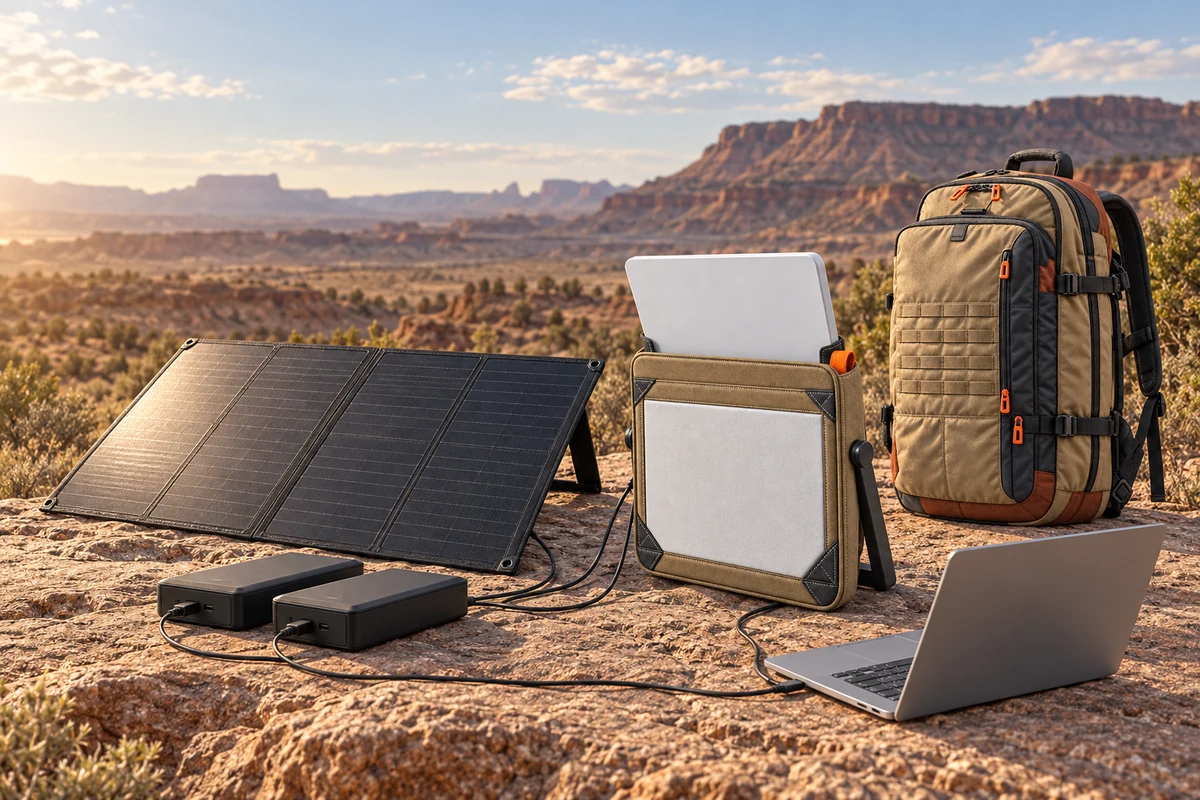
Two power banks, a 60 watt panel, a satellite terminal, a laptop and a phone. We did the arithmetic before designing the bag, and the answer was not the one we wanted.
BY FIELD // LAB / / 3 MIN READ
The question.
Can two airline legal power banks and a 60 watt folding panel run a Starlink Mini, a MacBook Air and a phone for a working day, with no mains power anywhere?
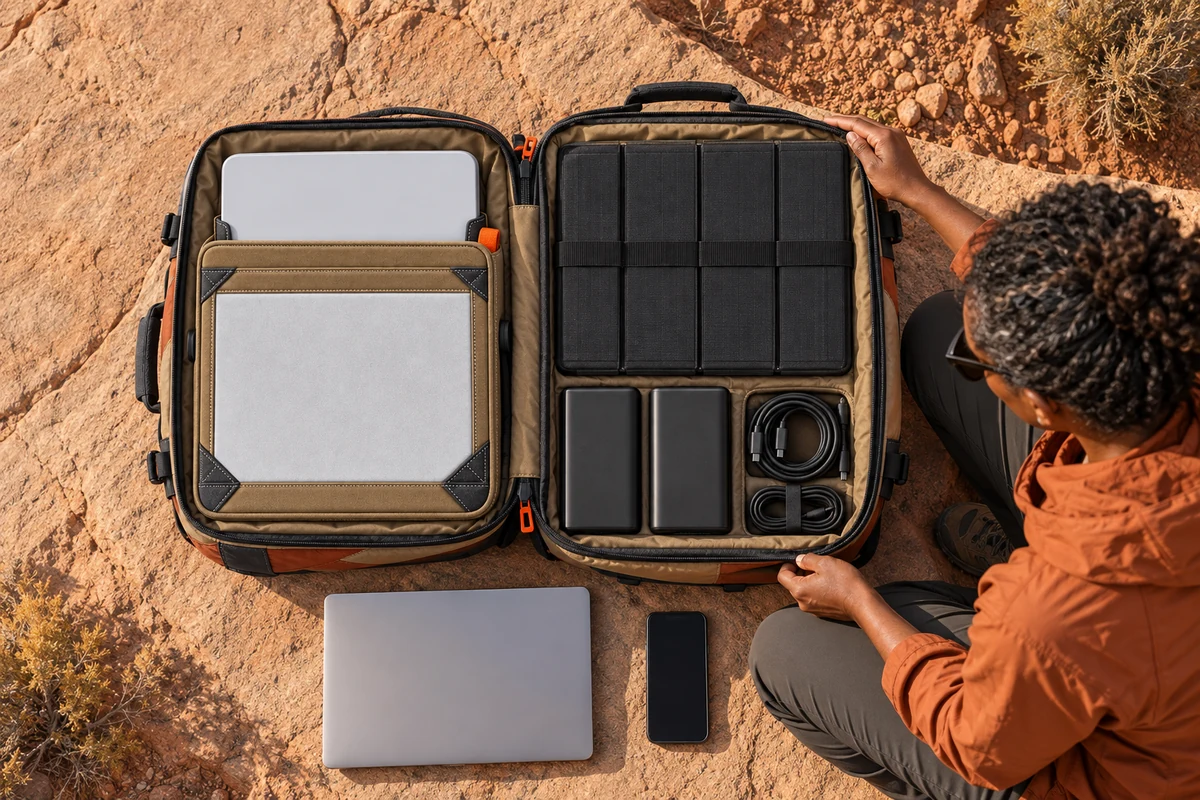
This matters to us because the Relay Bay, the Command Pack and the Nexus Organizer are all sized around that kit. If the answer is no, we are designing a bag for a setup that does not work.
So we did the arithmetic first. Every number below is either published by the manufacturer or derived from a published number, and we have said which is which.
What you actually get out of a battery.
A 27,650 mAh Anker Prime is rated 99.54 Wh, which is deliberate: 100 Wh is the ceiling you can carry onto an aircraft without airline approval. Two of them is 199 Wh on paper.
You do not get 199 Wh. Conversion from the cells to USB-C, and from USB-C into a device battery, costs you. Anker publishes the figure themselves without framing it as a loss: one bank charges a 13 inch MacBook Air about 1.28 times. That laptop battery is 52.6 Wh, so 1.28 charges is 67 Wh delivered out of 99.54 Wh stored.
That is 68 percent. Two banks therefore deliver about 135 Wh into devices, not 199. Use the nameplate number and your whole plan is a third too optimistic before you leave the house.
The budget, and the thing that eats it.
Starlink publishes 25 to 40 watts average for the Mini. Take 30 watts, which is the middle rather than the flattering end. Ten hours of that is 300 Wh.
The computer and the phone are almost noise by comparison. A full MacBook Air recharge is 52.6 Wh into the battery, about 78 Wh drawn from a bank once you account for the delivery loss. A phone is around 14 Wh into the battery, about 21 Wh drawn.
| Load | Into the device | Drawn from storage | Share |
|---|---|---|---|
| Satellite terminal, 30 W for 10 h | 300 Wh | 300 Wh | 75% |
| Laptop, one full recharge | 52.6 Wh | 78 Wh | 20% |
| Phone, one full recharge | 13.9 Wh | 21 Wh | 5% |
| Total | 398 Wh |
The answer is no, and by how much.
Two banks deliver 135 Wh. A 60 watt panel does not make 60 watts: manual aiming, heat and angle mean 55 to 70 percent of nameplate is realistic, across perhaps four or five usable hours. Call a good day 195 Wh and a mediocre one 132 Wh.
On a good day that is 330 Wh available against 398 Wh of demand. You are 68 Wh short, which is a little over two hours of terminal time. Feed the laptop and the phone first, as you would, and what is left supports about seven and a half hours of terminal on a good day and closer to five and a half on a cloudy one.
So the honest answer to a ten hour day with the terminal always on is no. Not by a catastrophic margin, but no.
Which changes the design, not the kit.
The interesting part is not the shortfall, it is the distribution. The terminal is three quarters of the budget on its own. Everything you would instinctively worry about, the laptop and the phone, is the other quarter combined.
That means the lever is not a bigger battery. Adding a third bank buys you another two and a quarter hours of terminal and costs you 600 grams and a carry-on argument. The lever is treating connectivity as something you schedule rather than something you leave on. Four hours of terminal, spread across the day, needs 120 Wh and leaves you 90 Wh of margin on the same kit.
That is why the Relay Bay is a bay you set down and deploy rather than a pocket you walk around with. You open it when you need the link. A terminal that is convenient to leave running is a terminal that flattens your batteries by mid afternoon.
What we have not proved.
None of this has been measured. It is arithmetic on published figures, and published figures are optimistic in ways that are hard to see. The 30 watt terminal average is a midpoint of a range that widens in cold weather and when the link is working hard. The solar harvest is the most variable number here by a wide margin and the one most likely to be worse than we have assumed.
The 68 percent delivery efficiency is derived from a marketing claim about charging a specific laptop, not from a bench measurement, and it will differ by cable, by charger and by state of charge.
We will publish the measured version when there is a sample to measure it with. Until then, treat this as the reason the bag is shaped the way it is, not as a performance claim.
Products in this note.
Keep reading.
03. Why we're not putting batteries in jackets04. One kit that moves between bags