One kit that moves between bags
We planned a docking interface between the packs and the carry-on, then cut it. This note covers what we kept, what we dropped and why.
BY FIELD // LAB / / 2 MIN READ
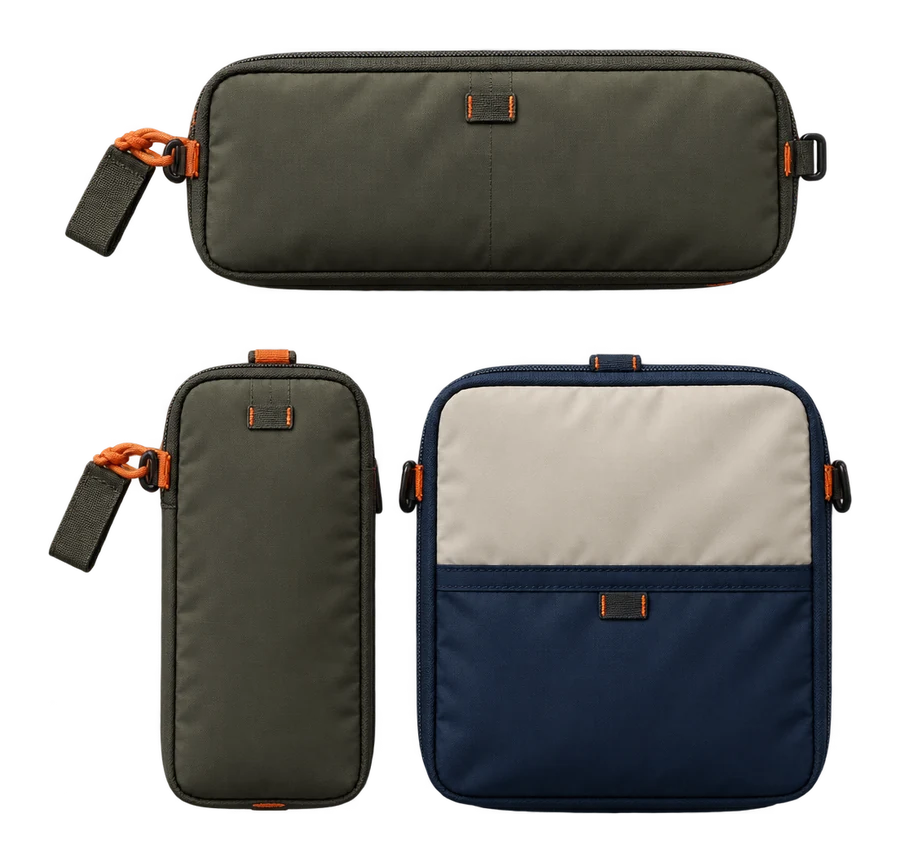
The problem with separate bags.
Most people who travel with technology own more than one bag. A daily backpack, something bigger for longer trips, a carry-on, maybe a sling. Each has its own organization, so every time you switch bags the kit gets rebuilt from memory.
That is where things go missing. The charger stays in yesterday's bag. The drive with the files you need is on the desk at home. It is a small cost, paid over and over.
What we cut.
The earlier plan had a hard interface between bags: a mount that would clip a pack onto the carry-on, one handed, at the gate. We have removed it.
The engineering was the easy part to describe and the hard part to deliver. A pack hanging off a case shell loads both parts every time a wheel hits a curb or a jet bridge threshold. The release has to be quick but never accidental. Soft bags and hard cases come from different factories, so a shared interface has to hit tolerances across two supply chains before a single unit ships.
None of that is impossible. It is just a large engineering program attached to a lineup that has not been made yet. Promising it now would have meant promising something we could not size, quote or test, and it would have locked the geometry of every bag that came after.
A luggage pass-through sleeve does most of the same job. It is proven, it costs almost nothing, and no factory has to invent anything.
What we kept.
Modularity inside the bag, where it earns its place. Nexus Organizer pouches for cables, power and drives are designed to clip or magnetically mount inside the Command Pack, the Traverse Travel Pack or the Horizon Carry-On. You set the kit up once and move the pouch, not the contents.
That is a far smaller problem than joining two loaded bags together. The loads are light, the failure case is a pouch coming loose inside a closed bag, and the parts can come from one supplier.
The Relay Bay follows the same rule. It mounts to the back panel of a pack, not to a suitcase, and it holds a terminal that will be replaced long before the bag is.
The rule we are designing to.
Modular where the load is light and the part is cheap to replace. Fixed where the load is heavy and the geometry has to last.
That rule is also why Drop 001 is clothing. The Atlas Overshirt, Axis Pant, Vector Fleece and Pivot Short can be made together by one apparel manufacturer. Carry needs hardware decisions we have not earned yet.
If a docking interface comes back, it will come back as a tested mechanism with a quote behind it, not as a line in a feature list.
Products in this note.
Keep reading.
03. Why we're not putting batteries in jackets05. EARTH vs. MARS: One system, two colorways